

Award Year
Graduation Year
Department
Award Category
Biography
Vice President of Technology, Amazon Project Kuiper
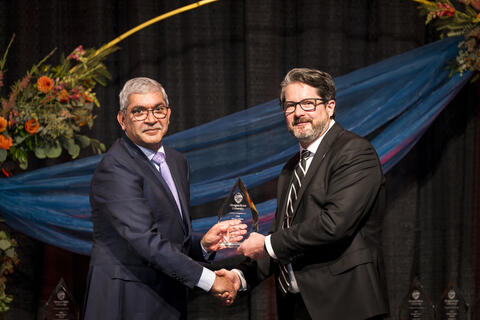
Rajeev Badyal’s career in satellite communications and consumer technology has shaped the way tens of millions of people connect and interact with the world. As Vice President of Technology and Head of Project Kuiper at Amazon, Badyal leads a $10 billion initiative to deploy a constellation of over 3,200 low Earth orbit satellites, bringing high-speed broadband to underserved communities globally.
“For the past seven years, I’ve been at Amazon leading Project Kuiper—an advanced LEO system aiming to bring fast, reliable internet to customers and communities around the world,” he said. “The potential impact is enormous, and it will definitely stand out as my proudest professional achievement to date.”
Badyal’s career began as a chip designer, followed by engineering leadership roles at Hewlett-Packard and Microsoft, where earned patents for integrated thermal inkjet printheads and chips used in optical mice — technologies still in use today. He holds more than 30 patents overall and is recognized for his ability to transform complex challenges into practical solutions.
“My experience at Oregon State set me on a path to continuously learn and be curious about technology,” he said. “What began in the classroom became the cornerstone of my career journey.”
Prior to Amazon, Badyal served as Vice President of Satellites and Rocket Avionics at SpaceX, playing a pivotal role in the Starlink project, which aims to deliver global internet coverage through a vast satellite constellation. His expertise and leadership have earned him a seat on the National Space Council Users’ Advisory Group, where he advises on U.S. space policy and strategy.
Badyal credits the College of Engineering for providing the foundational tools and problem-solving mindset that have guided his career.
“The faculty is incredible — they’re inspiring and so dedicated to their profession — and you’re not just learning engineering fundamentals,” he said. “You’re also learning practical skills that allow you to operate and succeed in the industry after graduation. On a personal level, I met my wife at OSU, and we’ve been married since.”